Astronomers have long been fascinated by the extreme conditions on tidally locked exoplanets—worlds where one hemisphere perpetually faces its star while the other remains in eternal darkness. Recent observations and simulations suggest that some of these planets may host vast oceans not of water, but of molten rock. This phenomenon, known as lava circulation, challenges our understanding of planetary geology and atmospheric dynamics in ways previously unimaginable.
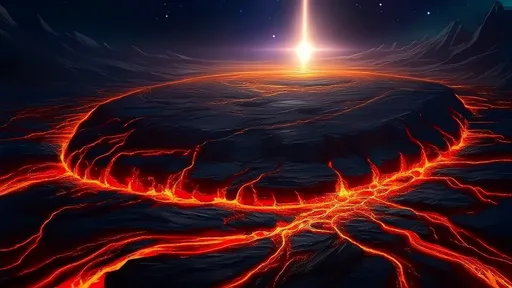
The concept of a liquid rock ocean might sound like science fiction, but the physics behind it is firmly rooted in reality. On Earth, we see small-scale versions of this process in active lava lakes, where molten rock churns and circulates due to heat from below. On a tidally locked exoplanet orbiting close to its star, the temperature differences between the day and night sides could create a planetary-scale version of this phenomenon. The dayside, blasted by relentless stellar radiation, would be hot enough to melt silicate rock, while the nightside might cool just enough for a thin crust to form—only to be recycled back into the molten interior.
What makes these lava oceans particularly intriguing is their potential to influence a planet's entire climate system. On Earth, ocean currents redistribute heat around the globe, regulating temperatures and weather patterns. A similar process could occur with lava oceans, albeit with vastly different materials and timescales. The viscosity of molten rock is orders of magnitude higher than water, meaning any circulation would be extremely slow by terrestrial standards. Yet over geological time, this creeping flow could transport enormous amounts of heat from the dayside to the nightside, potentially preventing the planet from becoming entirely uninhabitable on its dark side.
Recent computer models have revealed another surprising aspect of these systems: the possibility of "lava rain." Just as Earth's water cycle involves evaporation, cloud formation, and precipitation, some ultra-hot exoplanets might experience a silicate version of this process. On the scorching dayside, rock could vaporize into the atmosphere, only to condense into droplets of liquid rock that fall as rain on the slightly cooler terminator region—the borderline between eternal day and night. This would create a surreal landscape where "pebbles" form in the atmosphere and shower down onto a surface that's itself mostly liquid.
The discovery of such exotic planetary environments raises profound questions about the nature of habitability. While these lava worlds are clearly hostile to life as we know it, they demonstrate the incredible diversity of planetary systems in our galaxy. Understanding how materials behave under these extreme conditions could help scientists interpret data from future telescopes designed to study exoplanet atmospheres. Moreover, studying lava circulation provides insights into Earth's own distant past, when our planet's surface may have been partially or entirely molten during its formation.
As telescope technology improves, astronomers hope to detect direct evidence of these lava oceans. One promising approach involves looking for specific chemical signatures in exoplanet atmospheres that would indicate ongoing volcanic outgassing from a molten surface. Another method examines the way light reflects off these worlds—a liquid rock surface would have different reflective properties than a solid one, potentially detectable in the phase curves of these distant planets.
The study of lava circulation on tidally locked exoplanets represents a fascinating intersection of astronomy, geology, and fluid dynamics. It reminds us that the universe is far stranger and more wonderful than we often imagine, with processes occurring on distant worlds that defy our Earth-bound experiences. As we continue to explore the cosmos, we may find that these molten planets, while inhospitable to life, hold crucial clues about planetary formation and evolution throughout the galaxy.

By /Aug 14, 2025

By /Aug 14, 2025

By /Aug 14, 2025

By /Aug 14, 2025

By /Aug 14, 2025

By /Aug 14, 2025

By /Aug 14, 2025

By /Aug 14, 2025

By /Aug 14, 2025

By /Aug 14, 2025

By /Aug 14, 2025
By /Aug 14, 2025

By /Aug 14, 2025
By /Aug 14, 2025
By /Aug 14, 2025

By /Aug 14, 2025

By /Aug 14, 2025

By /Aug 14, 2025
By /Aug 14, 2025

By /Aug 14, 2025
